
JS手写题#
防抖节流#
防抖:在多次调用时,只触发最近一次调用,类似于——回城,一旦重新点击,重新开始
节流:调用一次后,就不能再次调用除非冷却时间过去——类似技能冷却
debounce
//debounce
function debounce(fn, times) {
    let timer;
    return function () {
        if (timer) {
            clearTimeout(timer)
        }
        timer = setTimeout(() => {
            timer = null
            fn.apply(this, ...arguments)
        }, times)
    }
}
throttle
function throttle(fn) {
      let flag = null; // 通过闭包保存一个标记
      return function () {
        if (flag) return; // 当定时器没有执行的时候标记永远是null
        flag = setTimeout(() => {
          fn.apply(this, arguments);
           // 最后在setTimeout执行完毕后再把标记设置为null(关键)
           // 表示可以执行下一次循环了。
          flag = null;
        }, 500);
      };
}不使用a标签实现,a标签的功能#
首先我们需要知道,a标签干了什么,a标签实现了跳转,而且是本页还是新开页面跳转,此外还有a标签上面的样式改变
document.querySelector('.a').addEventListener('click',()=>{
        window.location.href = 'https://www.baidu.com/'
        window.open('_blank')
    })
a标签的href就是location.href跳转的目标
window.open()即打开方式,即a的target,然后在修改部分样式即可达到
不使用循环API 来删除数组中指定位置的元素(如:删除第三位) 写越多越好#
//通过直接修改源数组
a.splice(2,1)
//拷贝数组
a.slice(0,2).concat(a.slice(3))

// 方法三 delete数组中的元素 再把这个元素给剔除掉
delete arr[2]
arr.join(" ").replaceAll(/\s{1,2}/g," ").split(" ")实现深/浅拷贝#
不考虑循环引用
浅拷贝#
1.使用解构
const obj = {
    a: 1,
    b: {
        c:2
    }
}

const objCopy = { ...obj };
objCopy.b.c = 3;
console.log(obj); // { a: 1, b: { c: 3 } }
console.log(objCopy); // { a: 1, b: { c: 3 } }
2.使用Object.assign
const obj = {
    a: 1,
    b: {
        c:2
    }
}
const obj1 = Object.assign({}, obj);
obj1.b.c = 4;
console.log(obj); // { a: 1, b: { c: 4 } }
console.log(obj1); // { a: 1, b: { c: 4 } }
3.使用遍历
const obj2 = {}
for (let key in obj) {
    if (obj.hasOwnProperty(key)) {
        obj2[key] = obj[key];
    }
}深拷贝#
1.手写深拷贝函数
//深拷贝
function deepCopy(obj) {
    if (typeof obj !== 'object' || obj === null) {
        return obj;
    }
    const newObj = Array.isArray(obj)? [] : {};
    for (let key in obj) {
        if (obj.hasOwnProperty(key)) {
            newObj[key] = deepCopy(obj[key]);
        }
    }
    return newObj;
}
//测试
const obj = {
    a: 1,
    b: 2,
    c: {
        d:[1,2,3]
    }
}
const newObj = deepCopy(obj)

console.log(newObj === obj)
newObj.c.d.push(4)
console.log('obj', obj)
console.log('newObj', newObj)
2.使用JSON
const newObj = JSON.parse(JSON.stringify(obj))如果出现循环引用,这两种方法都不行
//处理循环引用问题
const obj2 = {
    a:1
}
const obj1 = {
    a: 1,
    b:obj2
}
obj2.b = obj1
使用map进行存储,各个key然后可以实现拷贝
const deepCopyOptimization = (obj) => {
    const cache = new WeakMap();
    const copy = (obj) => {
        if (typeof obj !== 'object' || obj === null) {
            return obj;
        }
        if (cache.has(obj)) {
            return cache.get(obj);
        }
        const newObj = Array.isArray(obj)? [] : {};
        cache.set(obj, newObj);
        for (let key in obj) {
            if (obj.hasOwnProperty(key)) {
                newObj[key] = copy(obj[key]);
            }
        }
        return newObj;
    }
    return copy(obj);
}

const newObj2 = deepCopyOptimization(obj2)
const newObj1 = deepCopyOptimization(obj1)
console.log(newObj1)
console.log(newObj2)
console.log(newObj2.b === newObj2)手写Bind,Call,Apply#
首先我们应该知道,bind,call,apply分别做了什么
bind,在函数上调用,将其this指向传入的对象,并且返回一个函数
Function.prototype.myBind = function (context) {
    if (typeof this !== 'function') {
        throw new TypeError('Error: this is not a function');
    }
    if (context === undefined || context === null) {
        context = window;
    } else {
        context = Object(context);
    }
    const self = this;
    const args = [...arguments].slice(1)
    return function () {
        return self.apply(context, args.concat([...arguments]));
    }
}
call,在函数上调用,将其this指向传入的对象,第二个参数是正常传参,并且返回一个执行结果
Function.prototype.myCall = function (context) {
    if (typeof this !== 'function') {
        throw new TypeError('Error: this is not a function');
    }
    if (context === undefined || context === null) {
        context = window;
    } else {
        context = Object(context)
    }
    const args = [...arguments].slice(1);
    const sy = Symbol('fn')
    context[sy] = this;
    const result = context[sy](...args);
    delete context[sy];
    return result;
}apply在函数上调用,将其this指向传入的对象,第二个参数是数组,并且返回一个执行结果
Function.prototype.myApply = function (context) {
    if (typeof this !== 'function') {
        throw new TypeError('Error: this is not a function');
    }
    if (context === undefined || context === null) {
        context = window;
    } else {
        context = Object(context)
    }
    //因为是数组直接取第二位就行了

    const args = [...arguments][1];
    const sy = Symbol('fn')
    context[sy] = this;
    //这里要改变一下,因为传入的参数是一个数组需要结构一下
    const result = arguments.length > 1? context[sy](...args) : context[sy]();
    delete context[sy];
    return result;
}继承#
这里需要知道原型链相关的知识
ES6之前#
原型继承——即将子类的prototype指向为一个父类的实例
缺点:父类的引用类型,会被所有子类共享
//原型链继承
function Person() {
    this.shared = ['a', 'b', 'c']
}

function Student() {
}
Student.prototype = new Person()

let p = new Student("Mary", 25);

p.shared.push('d')
let s = new Student("John", 20, 3);

console.log('s.shared', s.shared) //s.shared [ 'a', 'b', 'c', 'd' ]
console.log('p.shared', p.shared) //  p.shared [ 'a', 'b', 'c', 'd' ]
2.构造函数继承
使用父类的构造函数来增强子类实例,等同于复制父类的实例给子类(不使用原型)
//构造函数继承
function Father(){
    this.colors = ['red', 'blue', 'green'];
    this.sayGoodbye = () =>{
        console.log('goodbye')
    }
}
Father.prototype.sayHello = function(){
    console.log('hello')
}
function Son() {
    Father.call(this)
}

let s = new Son()
let f = new Son()
s.colors.push('yellow')
console.log('s.colors', s.colors) //s.colors [ 'red', 'blue', 'green', 'yellow' ]
console.log('f.colors', f.colors) //f.colors [ 'red', 'blue', 'green' ]
s.sayGoodbye() //goodbye
s.sayHello()//报错,不存在这个东东
console.log(s.sayGoodbye === f.sayGoodbye) // false核心代码是Father.call(this),创建子类实例时调用Father构造函数,于是Son的每个实例都会将SuperType中的属性复制一份。
但是,只能继承父类的实例属性和方法,原型上的不可得到,而且每个子类都有父类的实例函数副本,没有实现复用,浪费性能
组合继承
结合了上面两者的优点,使用原型链进行原型继承,借用构造函数实现实例属性的继承
//组合继承
function Parent(name) {
    this.name = name
    this.colors = ['red', 'blue', 'green']
}
Parent.prototype.sayHello = function () {
    console.log('hello')
}
function Child(name, age) {
    Parent.call(this, name)
    this.age = age
}
Child.prototype = new Parent()
Child.prototype.constructor = Child

let c = new Child('Tom', 20)
let b = new Child('Jerry', 25)
c.colors.push('yellow')
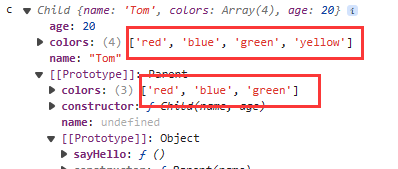
console.log('c', c) // c Child { name: 'Tom',colors: [ 'red', 'blue', 'green', 'yellow' ], age: 20}
console.log('b', b) // b Child { name: 'Jerry', colors: [ 'red', 'blue', 'green' ], age: 25 }
console.log(c.sayHello === b.sayHello) // true
    console.log('child',Child.prototype)
缺点:会给Child.prototype添加两个属性“name”和“colors”
而且会给Child的实例上添加name和colors属性

寄生继承
核心:在原型式继承的基础上,增强对象,返回构造函数
function createAnother(original){
  var clone = object(original); // 通过调用 object() 函数创建一个新对象
  clone.sayHi = function(){  // 以某种方式来增强对象
    alert("hi");
  };
  return clone; // 返回这个对象
}

var person = {
  name: "Nicholas",
  friends: ["Shelby", "Court", "Van"]
};
var anotherPerson = createAnother(person);
anotherPerson.sayHi(); //"hi"
缺点:原型链继承多个实例的引用类型属性指向相同,存在篡改的可能。无法传递参数
组合寄生继承
最成熟的方法,也是当前库所有 的方法
//寄生组合继承
function inheritPrototype(child, parent) {
    var prototype = Object.create(parent.prototype);// 创建对象,创建父类原型的一个副本
    prototype.constructor = child; // 增强对象,弥补因重写原型而失去的默认的constructor 属性
    child.prototype = prototype; // 指定对象,将新创建的对象赋值给子类的原型
}
function Parent(name) {

    this.name = name;
    this.colors = ["red", "blue", "green"];
}
function Child(name, age) {
    Parent.call(this, name); // 调用父类的构造函数,并传入参数
    this.age = age;
}
inheritPrototype(Child, Parent); // 继承父类原型

Parent.prototype.sayName = function () {
    console.log(this.name);
}

var child1 = new Child("John", 25);
var child2 = new Child("Mary", 30);
child1.colors.push("yellow");
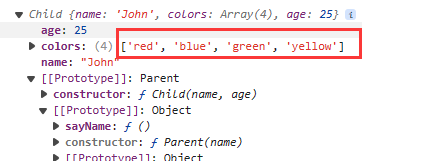
console.log(child1)
console.log(child2)
只有子类实例上有方法,而父类没有
ES6及之后#
class Person {
    constructor(name) {
        this.name = name;
    }

    sayHello() {
        console.log(`Hello, my name is ${this.name}`);
    }
}
class Child extends Person {
    constructor(name, age) {
        super(name)
        this.age = age;
    }
}
const child1 = new Child('John', 10);
child1.sayHello(); // Output: Hello, my name is John
console.log(child1); //
实现new操作符#
首先,我们需要知道new操作符,干了什么。
new操作符,创建了一个对象,然后将属性附加在对象上
function myNew(constructor, ...args) {
    const obj = Object.create(constructor.prototype);

    const result = constructor.call(obj, ...args)
    return typeof result === 'object' ? result : obj
}
如何拦截全局Promise reject,但并没有设定 reject处理器 时候的错误#
try catch只能拦截这个块里面的
可以给window对象添加一个unhandledrejection方法
// 使用 unhandledrejection 来拦截全局错误  (这个是对的)
window.addEventListener("unhandledrejection", (event) => {
  event && event.preventDefault();
  console.log("event", event);
});手写实现sleep#
(async function () {
    console.log('start sleep');
    await sleep(3000)
    console.log('end sleep')
    function sleep(ms) {
        return new Promise(res => {
            setTimeout(() => {
                res()
            }, ms)
        })
    }
})()
通过await异步阻塞
通过while循环完全阻塞进程
(function () {
    console.log('start sleep');
    sleep(3000)
    console.log('end sleep')
    function sleep(ms) {
        const start = Date.now()
        while (Date.now() - start < ms) {
            // continue;
        }
    }
})()实现add(1)(2)#
function add(x) {
    let sum = x;
    let temp = function (y) {
        sum += y;
        return temp
    }
    temp.toString = function () {
        return sum;
    }
    return temp;
}
alert(add(1)(2)(1)(2)); //3
这里利用了alert参数为string 的方法,如果不是string会调用toString()
数组分组改成减法运算#
比如[5,[[4,3],2],1]换为(5-((4-3)-2)-1)
1.转化为字符串然后进行遍历替换
//比如`[5,[[4,3],2],1]`换为`(5-((4-3)-2)-1)`
const arr = [5, [[4, 3], 2], 1]
console.log(JSON.stringify(arr).split(''))

const fn = JSON.stringify(arr).split('').map(item => {
    if (item === ',') return '-'
    else if (item === '[') return '('
    else if (item === ']') return ')'
    else return item
}).join('')
let res = new Function(`return ${fn}`)()
console.log(res) // 5
reduce的递归调用
const convert = (arr) => {
    return arr.reduce((pre, cur) => {
        const first = Array.isArray(pre) ? convert(pre) : pre
        const second = Array.isArray(cur) ? convert(cur) : cur
        return first - second
    })
}

console.log(convert(arr)) // 5
手写flat
const flat = (arr, deep = 1) => {
    const res = []
    for (let a of arr) {
        if (Array.isArray(a) && deep > 0) {
            res.push(...flat(a,deep-1))
        } else {
            res.push(a)
        }
    }
    return res
}
还有巧计,只求最大的话
arr.toString().split(',').map(Number)等同于
arr.flat(Infinity)数组转为tree#
function convert(arr,parentId){
        const filter = arr.filter((item)=>{
            return parentId === undefined? item.parent === -1 : item.parent === parentId
        })
        return filter.map(item=>{
            item.childNode = convert(arr,item.id)
            return item
        })
    }